If you follow a few diving accounts on Instagram, you’ve probably seen the question pop up: is my dive computer calculated for my body? To answer it, we did two things. We read the studies. And we asked Ksenia, who trained with us for five months, diving every single day, all the way to Divemaster.

Ksenia, when you started out, did you ever wonder about this?
Hello, dear readers! Of course, at the very start of your diving journey, hardly anyone thinks about their computer settings or digs into such detailed topics. Like most people, I was fixated on my ears, my buoyancy and dive safety in general.
What your computer (actually) does
Your computer doesn’t “see” your body. It measures depth and time, and runs a mathematical model (Bühlmann, RGBM or an in-house variant depending on the brand) that estimates how nitrogen loads into and out of theoretical “compartments”. These models were fitted to series of test dives, then made more or less cautious by the manufacturers.
None of the mainstream algorithms asks for your sex, your cycle, your contraception or your body composition. What you can adjust is their level of conservatism.
You’ll often read that these models were “built only on men”. A good share of historical testing came from the military world, but we haven’t found a source that puts a number on how many women took part in those trials, so we’d rather not claim it. What is certain is that researchers themselves now name sex as a variable to add to tomorrow’s models. A June 2026 paper in Frontiers in Physiology mentions it explicitly, alongside age and cold.
And how did you set up your computer?
At first my conservatism was on the computer’s basic settings: gradient factors 40/85 and a maximum PpO2 of 1.4. But because I was diving every day, and also because of the changes that come with the female cycle, I decided a more conservative approach would clearly raise my level of safety, and I switched to gradient factors 35/75 (high).
These are Ksenia’s settings on her own computer. Names and values vary by brand: ask your instructor to show you yours.
What recent studies say
The strongest signal comes from DAN Europe. In 2026, a team led by Alessandro Marroni analysed nearly 128,000 recreational dives logged by almost 6,000 divers in the DAN database. Among women, decompression sickness was recorded on 1.25% of dives, against 0.38% among men — roughly 3.3 times higher. The link held even after accounting for other factors (dive profile, exertion and so on). The suggested explanations (blood clotting, inflammatory response) still rest mostly on animal studies: it’s an association, not an explanation.
But not every study points the same way. In 2002, a survey by the Diving Diseases Research Centre in Plymouth of 2,250 recreational divers, 47% of them women, found the opposite: a rate higher in men (about 2.6 times) once experience was taken into account. Different methods, eras and populations: the question is still open.
Either way, other factors matter for everyone, especially physical exertion before and during the dive.
Five months of diving every day: how did your body react?
The first month, the heavy workload mostly affected my mood: fatigue, nervousness and a bit of weakness, while my body adapted to new, unfamiliar conditions. Then I adjusted my diet, started drinking a lot more water and tried to avoid exertion after dives. That helps your body work normally under stress — not just in diving, but in any job that’s physically demanding. What also helped me feel better was regular sleep, relaxation and, of course, knowing that if I felt unwell the team would support me, and that it was better to pause diving for a few days. In our job, you need to be 100% focused.
The cycle and the pill: leads, not certainties
- A DAN review of 956 women divers treated for decompression illness: 38% were menstruating at the time of the incident, and 85% of those taking the pill. But there was no comparison group, and DAN writes that these findings suggest, but do not prove, an increased risk.
- A 2003 study (Lee et al., 150 women, 23 centres): more incidents in the first week of the cycle, with a different pattern depending on pill use.
Nobody can put a number on risk by cycle phase today. And diving during your period is not contraindicated.
Did you adapt your dives during your period? Was it easy to talk about?
Honestly, the female body is an unpredictable bomb inside each of us, and I can’t give every woman the same advice. In my experience, I handled dives during my period fairly easily. I asked the team to lighten my load on those days, because my body was weaker anyway. Shallower, less frequent dives helped me feel better. And of course I wasn’t afraid to talk about it, because my health comes first.
In practice: dive with a wider margin
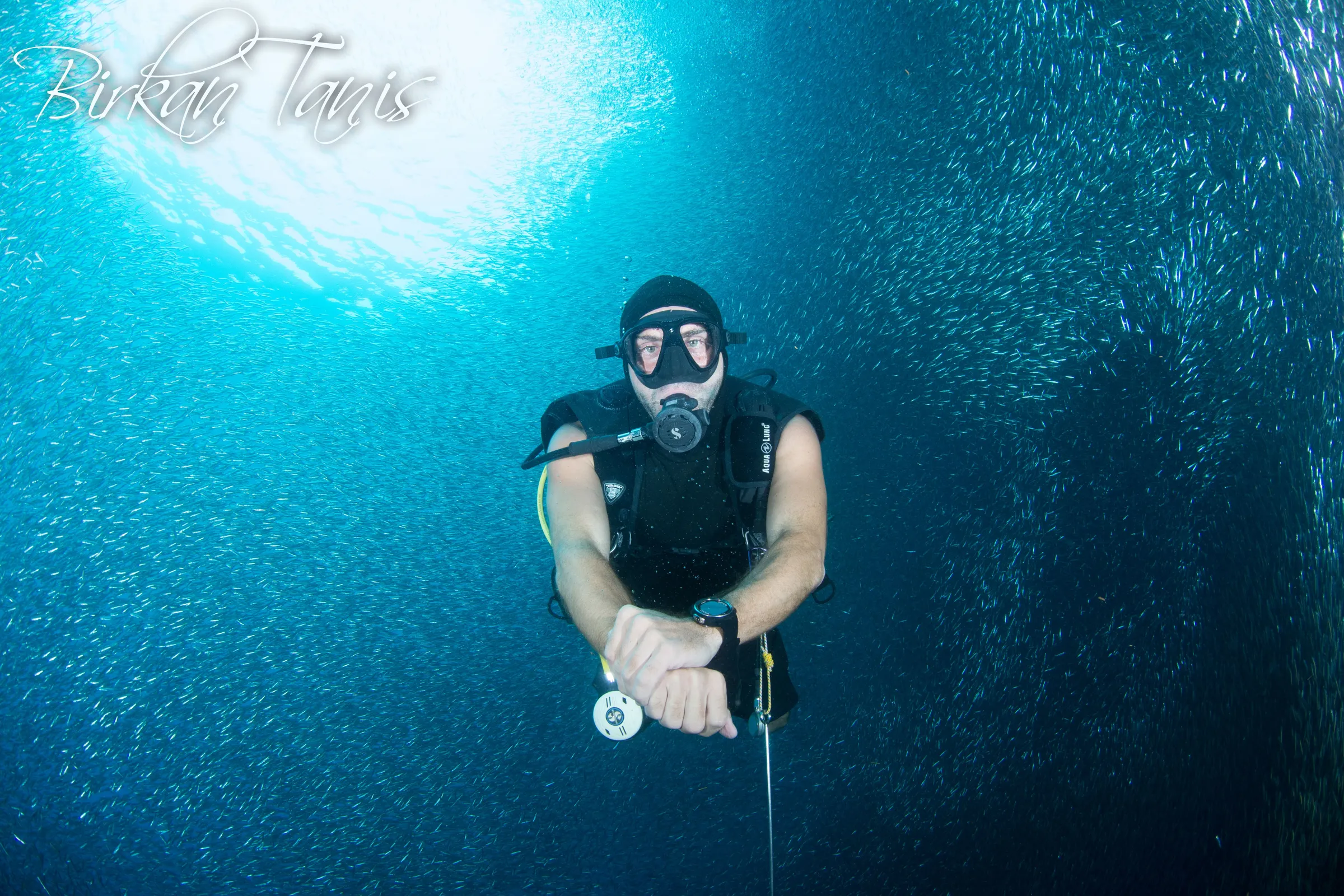
- Set your computer to a more conservative mode: gradient factors (GF) or a personal adjustment level (P1, P2…). Your instructor can show you where to find it.
- Keep a margin: head up before the computer forces you to, extend your safety stop, space out repetitive dives.
- During your period, and especially if you’re on the pill, DAN advises slightly shallower and shorter dives, fewer dives in the day and longer stops.
- Limit exertion before, during and right after the dive, drink enough and stay warm.
- Consider Nitrox while keeping your computer set to air: you breathe less nitrogen while staying within the limits calculated for air. Our Nitrox course explains how.
- Talk about it, no embarrassment, with your instructor, and with your doctor or gynaecologist for any health question.
- At the slightest symptom after a dive (unusual fatigue, joint pain, tingling, skin rash), report it straight away.
Your advice to a woman who’s just starting out?
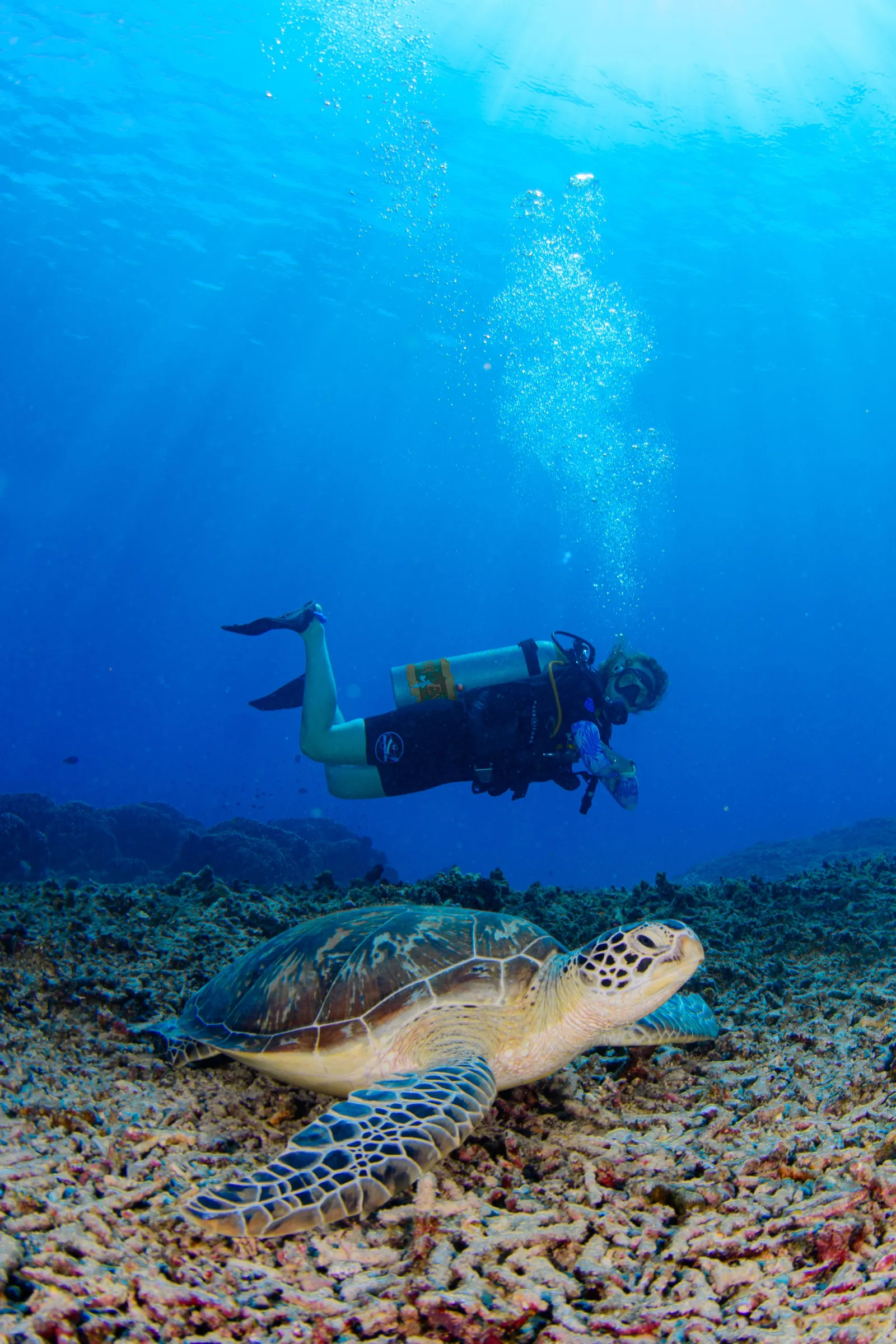
To be honest, when I was just starting out as a diver, I had loads of questions for my instructor — I wanted to know every possible detail. In diving there are no stupid or out-of-place questions; we all know how exciting it is to try something for the first time. So if you’ve made up your mind, go for it: ask questions, practise all the skills again and again, and don’t worry about how you look — underwater, the turtles won’t be taking selfies with you. And above all, think about your health, because our female bodies are more fragile.
What do you wish you’d known sooner?
Without a doubt: I’d have liked to know my computer’s settings in more detail, how they affect the female body specifically, and which kinds of exertion to avoid during my cycle.
The last word
The question is finally being asked, and seriously: the data is coming in, and tomorrow’s models may well include individual parameters. In the meantime, take Ksenia’s advice: get to know your computer’s settings from your very first dives, and never hesitate to ask questions.
Want to talk it through with an instructor before getting back in the water? A refresher is the perfect chance. Or just message us on WhatsApp.
This article is for information only and is not a substitute for medical advice.
Sources
- Marroni A., Kot J., Pieri M., Pelliccia R., Balestra C. — Identification of DCS risk factors in recreational diving: multifactorial model based on the DAN DSL Database 2024, International Maritime Health, 2026, 77(1). Link
- Schirato S. R. et al. — A gradient-based optimization model for predicting decompression sickness risk, Frontiers in Physiology, June 2026. Link
- St Leger Dowse M., Bryson P., Gunby A., Fife W. — Comparative data from 2250 male and female sports divers: diving patterns and decompression sickness, Aviat Space Environ Med, 2002, 73(8). PMID 12182213. DDRC PDF
- Lee V., St Leger Dowse M., Edge C., Gunby A., Bryson P. — Decompression sickness in women: a possible relationship with the menstrual cycle, Aviat Space Environ Med, 2003, 74(11). PMID 14620475. DDRC PDF
- DAN — Menstruation During Diving Activities. Link
Keep reading
Before you dive again: be honest with yourself, be fair to your group
Is freediving for me? An honest answer
Diving Gili Air in the rainy season: is it worth it?
Freediving on Gili Air: the complete guide
Freediving in Indonesia: where to go, and for whom
Freediving safety: why you never dive alone
Freediving or scuba diving: which one is for you?

The Wallace Line: the invisible border running straight through the Lombok Strait
GoPro and action-cam settings for the Gili Islands: what actually works underwater