
Some dives at the Gilis are an easy glide along a reef wall. Others hand you a current strong enough to turn a fin kick into a formality, or a thermocline so sharp you can feel the exact metre where warm water ends and cold begins. Neither is random. Both are the local signature of one of the planet’s largest ocean-current systems passing directly beside Gili Air on its way out of the Indonesian archipelago.
What the Indonesian Throughflow actually is
The Pacific and Indian Oceans sit at slightly different sea levels, piled up by trade winds pushing warm Pacific water westward. That imbalance has to go somewhere, and the only way through is straight across Indonesia — through the maze of straits between its thousands of islands. Oceanographers call this transfer the Indonesian Throughflow (ITF): a continuous flow of warm, relatively fresh Pacific surface water pouring into the Indian Ocean through the archipelago, at a volume that rivals the world’s biggest ocean currents.
Most of that flow funnels down through the Makassar Strait between Borneo and Sulawesi, then has to find a way out into the Indian Ocean. The Lombok Strait — the same deep channel behind the Wallace Line — is one of its main exit routes, alongside the Ombai Strait and Timor Passage further east. It’s narrower and shallower than those, which means the same volume of water has to move through a tighter gap: a recipe for strong, tide-driven currents right past the Gili Islands.
What it feels like on a dive
Current. The throughflow doesn’t run at one constant speed — it’s layered on top of the ordinary tidal cycle, which is why conditions swing so much with the moon. Our guides already brief every dive around this: expect a gentle drift most days, and a genuinely strong pull around new and full moon, when the tidal push adds to the throughflow rather than fighting it. Shark Point shows this most clearly — the same site can be an effortless drift one week and a dive only Advanced divers should take the next.
Thermoclines. Because the throughflow carries water from different depths and origins, it isn’t thermally uniform. It’s common to drop through a sharp thermocline on a dive here — a metre or two where the temperature noticeably falls — as you pass from surface-warmed water into a cooler layer the current has pushed up from depth. Bring a thicker wetsuit than the surface temperature alone would suggest if you’re diving past 20 m.
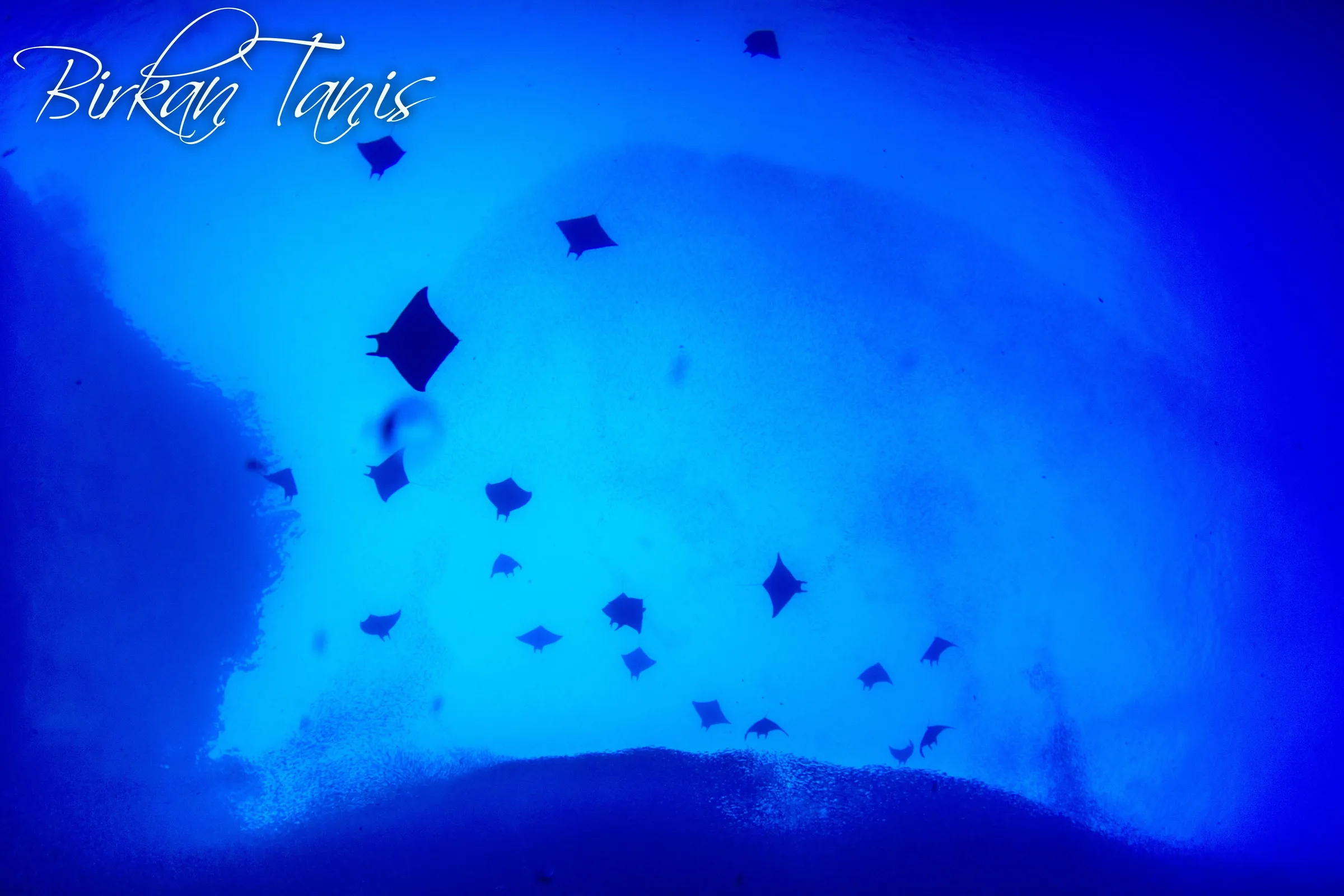
Visibility and nutrients. The same deep water the throughflow pushes upward is nutrient-rich, which cuts both ways. It’s part of why visibility drops and the water turns greener in the wet season (see our month-by-month guide) — more nutrients mean more plankton, and plankton scatters light. But that same nutrient load is exactly what feeds the food chain behind the Gilis’ biggest seasonal draw: it’s no coincidence that manta rays and mola mola show up precisely when this upwelling is strongest, and it’s the same current system that occasionally sweeps a whale shark past the outer pinnacles.
Why this matters for planning your trip
None of this changes the basics — Gili Air dives year-round in 28°C water, and our guides assess current and conditions before every single entry, every single day. But it’s the real explanation behind two things divers often ask about: why the current here can be stronger than other spots they’ve dived, and why the “best” visibility month isn’t automatically the month with the best marine life. The throughflow is the common thread behind both — and it’s one of the reasons the Gili Islands punch so far above their size for diving.
Want the practical side of planning around this? Our best dive sites guide and month-by-month breakdown cover exactly when and where to dive it.