
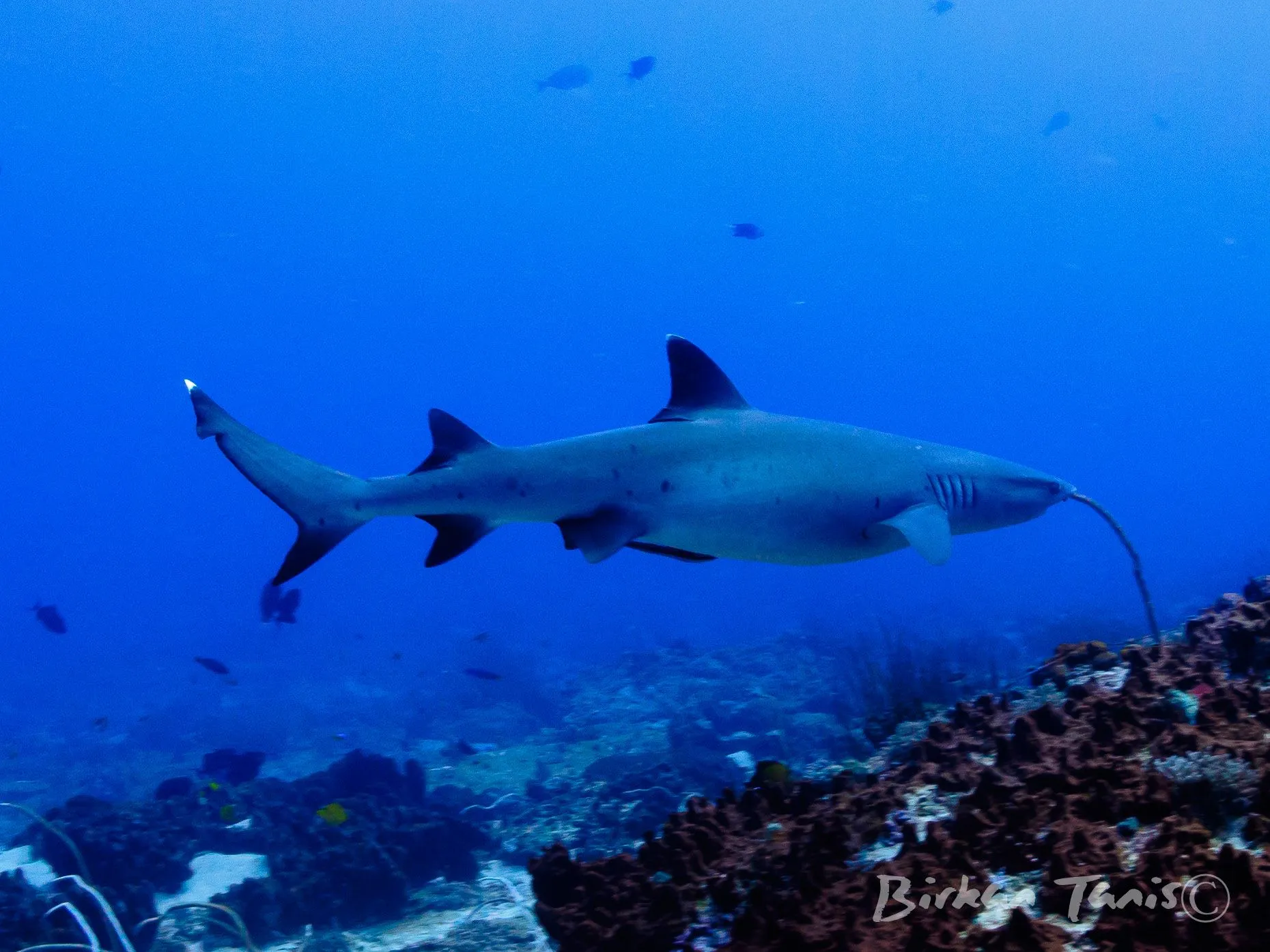
The first time most divers see a whitetip reef shark, it’s lying motionless on the sand, and the instinct is to assume something’s wrong with it. Nothing is. This is a shark built to rest — and the Gili Islands are one of the more reliable places nearby to watch one do it up close.
Where to find them
Short answer
Whitetip reef sharks turn up reliably at four Gili dive sites: resting on the sandy canyon floors of Shark Point (28–30 m), as a known resident under the stern of the Glenn Nusa wreck, circling below 24 m at Jack Point, and occasionally at Deep Turbo alongside blacktip reef sharks.
Shark Point earns its name honestly — whitetips rest on the sandy canyon floors at 28–30 m between excursions to the open reef, while blacktip and the occasional grey reef shark cruise the canyon lips above. It’s the most requested site in the Gilis; book it early in your stay if it’s on your list.
The Glenn Nusa wreck has carried a resident whitetip since roughly its first year underwater — it’s most reliably found resting under the stern, which makes a full exterior circuit before any wreck penetration worth doing on every dive.
At Jack Point, whitetip and blacktip reef sharks circle the ridge structure in the deeper water below 24 m, usually while schools of big-eye trevally spin overhead. Deep Turbo adds blacktips patrolling the outer edge of the pinnacle, alongside the occasional resting leopard shark on the sand.
Why they’re “sleeping” in broad daylight
Short answer
Whitetip reef sharks are nocturnal hunters that spend daylight hours resting in caves or on open sand. Unlike many shark species that must keep swimming to breathe, whitetips can actively pump water over their gills while stationary — one of the few sharks able to rest completely still.
Most people’s mental image of a shark is a creature that never stops moving, because most sharks are obligate ram ventilators — they need water flowing over their gills constantly, which means swimming constantly. Whitetip reef sharks are built differently: they can actively pump water over their gills while lying still, the same trick that lets nurse sharks nap in caves. That’s the whole mystery solved — the shark isn’t sick, stunned, or stranded. It’s just built to rest.
They’re also creatures of habit in a way most reef fish aren’t: research on the species shows strong site fidelity — an individual whitetip will typically stay within a small home range for its entire life, returning to the same cave or stretch of sand day after day. It’s part of why the Glenn Nusa’s shark has stuck around since the wreck’s first year; once a whitetip picks a good resting spot, it rarely leaves.
Come back after dark and the same animal is a different creature entirely — awake, hunting reef fish, crabs and octopus along the bottom with a mouth shaped for scooping prey off the sand rather than for anything larger.
Are they dangerous?
Short answer
No. Whitetip reef sharks are small (typically around 1.6 m, rarely over 2 m), feed on reef fish and crustaceans, and are considered one of the more docile reef shark species — divers routinely swim within a few metres of a resting whitetip without incident.
They’re a medium-sized shark at best — averaging around 1.6 metres, occasionally reaching 2 — with a small, downward-facing mouth built for picking prey off the seafloor, not for anything resembling a diver. Combined with a genuinely calm temperament, whitetip reef sharks are one of the species most divers actually hope to see rather than worry about.
Diving with them respectfully
- Keep your distance from cave entrances. A resting whitetip that feels cornered will simply swim away — give it the option.
- No chasing, no touching. Site-faithful animals like this one are easy to disturb repeatedly if divers crowd the same spot; a calm approach means the next diver gets to see it too.
- Buoyancy matters here more than usual — most sightings happen close to sand, and a fin-kick into the bottom stirs up silt that ruins the visibility for everyone, shark included.
Shark Point, Jack Point, Deep Turbo and the Glenn Nusa all run as regular boat trips from the centre. Ask about pairing a shark-focused day with a multi-dive pack, or read the Glenn Nusa dive-site profile for the full wreck write-up.