Most people picture the Gilis as reef and turtle territory — which is fair, that’s most of the diving. But two purpose-built and accidental wrecks sit within a short boat ride of the centre, and they dive nothing alike. One is a deep, current-swept tugboat with a shark in residence. The other is a shallow, coral-swallowed pier that’s become one of the best macro sites in the islands.
Glenn Nusa: the tugboat with a shark
Short answer
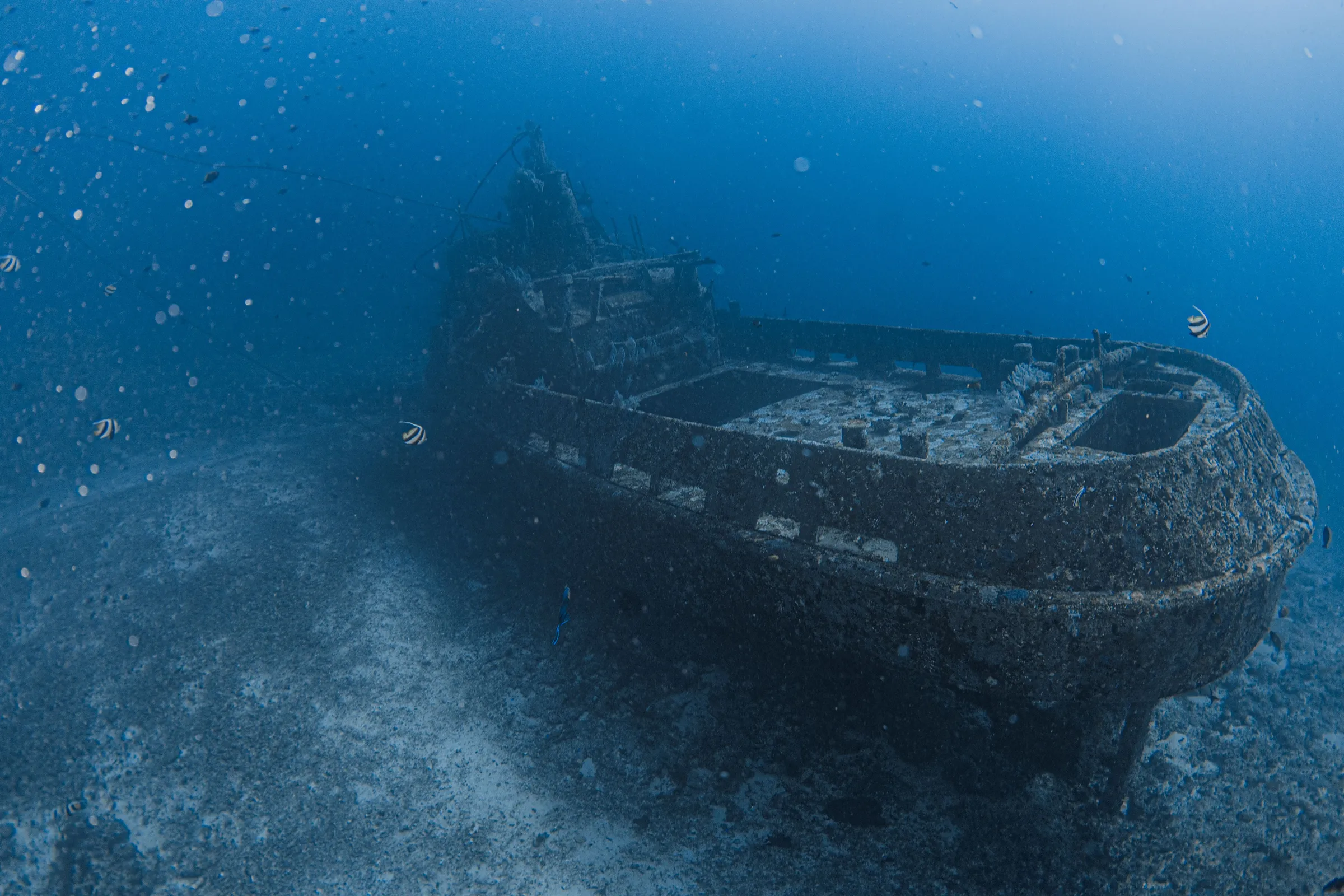
The Glenn Nusa I is a 22 m tugboat deliberately sunk in 2016 between Halik Reef and Shark Point, off the north side of Gili Trawangan. It sits upright at 28–30 m, hosts a resident whitetip reef shark, and requires Advanced Open Water as a minimum.
The Glenn Nusa was purchased, stripped of contaminants, and sunk on purpose — a proper artificial reef, not an accident. Nine years of coral growth later, it’s colonised fast: schools of black snapper and oriental sweetlips circle the superstructure, trevally hold above the wheelhouse, and a whitetip reef shark has lived on the wreck since its first year, usually found resting under the stern.
Because it was cleaned before sinking, wreck-trained divers can enter the interior safely — portholes and passageways that smaller fish have already claimed as their own. The depth means current and visibility depend on the day; check conditions, and bring Nitrox if you’re certified for it, since 28–30 m disappears fast on air.
Who it’s for: certified divers Advanced Open Water and up, comfortable with depth and current. Full dive-site profile here.
The Bounty Wreck: a pier turned macro paradise
Short answer
The Bounty Wreck off Gili Meno started life as a wooden pier, knocked into the sea by a 2001 storm. Two decades of coral growth later it sits at 8–18 m, thick with scorpionfish, frogfish and a resident cloud of glassfish — an easy, photogenic site open to Open Water divers.
Nothing about the Bounty was planned — it fell, and the reef took over. That accident is now one of the most reliable macro sites in the Gilis: scorpionfish and frogfish in multiple colour morphs sit in plain view on the hull if you know where to look, ghost pipefish hover near the crinoids, and peacock mantis shrimp dart between coral-covered decking. A large bommie beside the main structure shelters a permanent cloud of glassfish that shivers and parts around passing divers.
Depth tops out around 18 m and current is usually light — friendly enough for Open Water divers, and a favourite second or third dive of the day, plus a strong night-diving site. Look south of the wreck for a pair of old bicycles, now entirely coral-draped — the most photographed subject on the site.
Who it’s for: any certified diver, especially anyone bringing a camera. Full dive-site profile here.
Further out: the deep Japanese wreck
Short answer
A WWII-era Japanese submarine chaser rests at around 45 m off the Lombok coast — a technical, decompression dive well beyond recreational limits, for tec-qualified divers only.
A third wreck belongs in this story for completeness, not as a trip we run: a Japanese vessel from WWII sits much deeper, around 45 m, coral-covered after eight decades underwater. It’s a real technical dive — decompression stops, Nitrox or better, and serious depth experience required — squarely outside recreational limits. If that’s the kind of diving you’re chasing, our Deep Diver specialty is the honest first step, and we’re happy to point you toward the technical operators who run it properly.
Which wreck for you?
- New to wrecks, Open Water certified: the Bounty. Shallow, forgiving, and stacked with things to photograph.
- Advanced Open Water, want depth and a shark: Glenn Nusa.
- Want to go inside a wreck: the Wreck Diver specialty opens up the Glenn Nusa’s interior properly.
- Chasing something technical: talk to us about Nitrox and Deep Diver first — the Japanese wreck is a destination to train toward, not a walk-in trip.
Both the Glenn Nusa and the Bounty run as regular boat trips from the centre — ask about pairing one with a fun-dive pack for the week.