
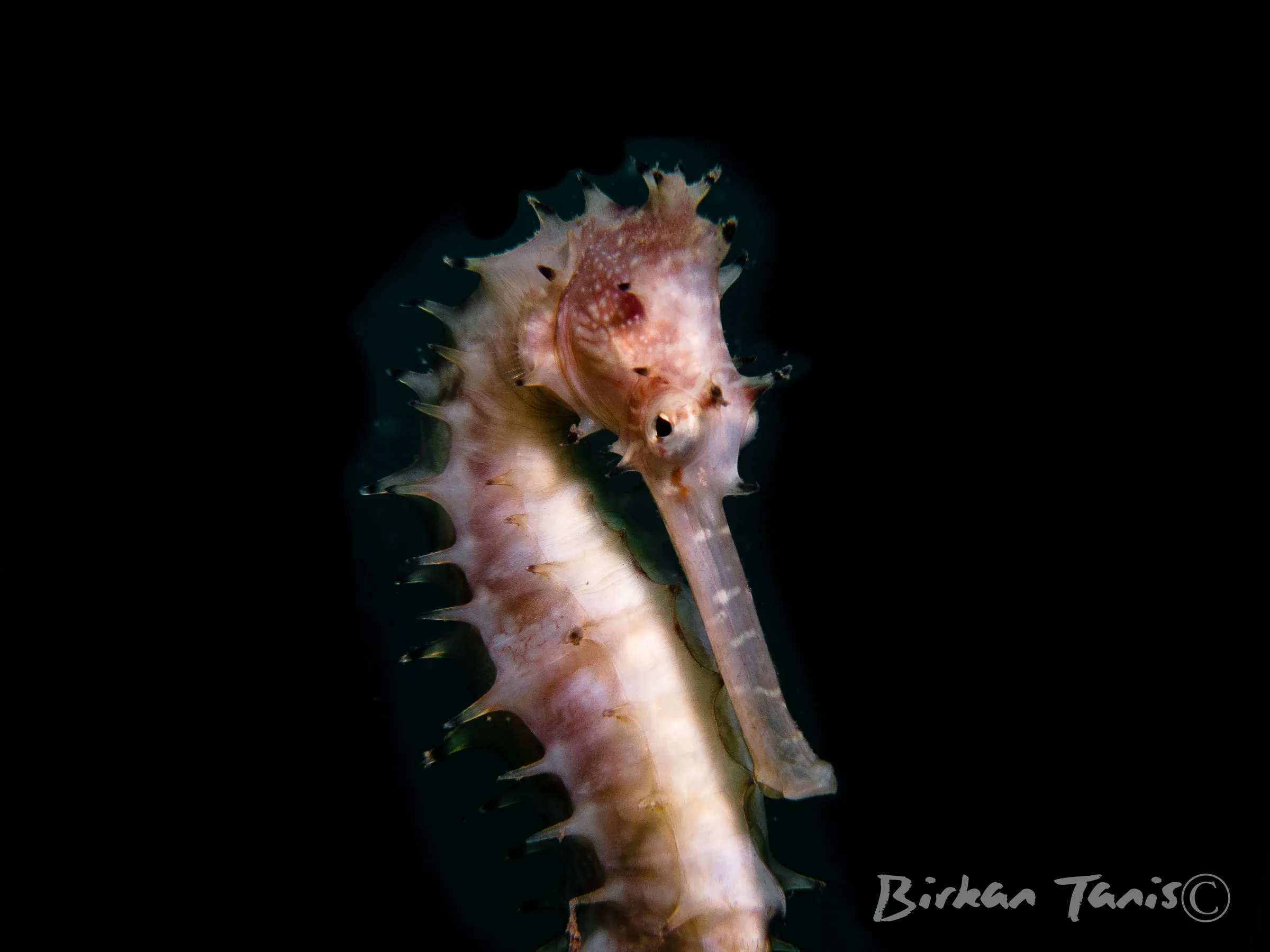
Seahorses don’t swim so much as commute — a few slow pumps of a nearly invisible dorsal fin, then a tail wrapped tight around whatever will hold it. That stillness is exactly why they’re hard to find and, once your eye learns the shape, suddenly everywhere. The Gilis and the Lombok muck coast nearby host an unusual range of the family: true seahorses down to pygmy size, the theatrical ghost pipefish, and their straighter-bodied pipefish cousins. Here’s where each one actually lives.
Kecinan Seahorse Bay: the site named for them
Short answer
Kecinan Seahorse Bay, a muck-diving site on the Lombok coast about 30 minutes by boat from Gili Air, holds three established seahorse species — common, zebra-snout and thorny — living in its sea-grass meadows and coral patches, alongside harlequin and seagrass ghost pipefish.
This crescent-shaped bay earns its name honestly. Three seahorse species hold established territories here — the common seahorse, the zebra-snout seahorse, and the thorny seahorse — and expert guides who dive the bay regularly know roughly where each one has been settled for weeks or months at a time. That’s the difference between a lucky sighting and a reliable one: on a good dive, multiple individuals turn up across the sea grass and coral rubble.
The same sandy slope hosts harlequin ghost pipefish and seagrass ghost pipefish, both masters of matching their background so closely that guides often spot them before their tails have even stopped swaying. Add mimic octopus, blue-ring octopus, flamboyant cuttlefish and the occasional rhinopias, and Kecinan is less a single-species site than a full muck-diving inventory — one reason serious macro photographers treat it as a destination in its own right rather than an add-on.
Practical notes: shallow (3–25 m), essentially current-free, best April–October, and a slow dive by design — budget 60–70 minutes and let the guide lead you between known territories rather than searching at random. Full dive-site profile here.
Pygmy seahorses on the reef
Short answer
Pygmy seahorses — barely 2 cm and colour-matched to the gorgonian fans they grip — turn up on five Gili dive sites: Air Slope, Deep Turbo, Meno Slope, Simon's Reef and Takat Penyu. Indonesia is the world epicentre for the family: most of the roughly nine recognised species were first described here.
A pygmy seahorse is genuinely tiny — most species top out around 2 cm — and it doesn’t hide so much as disappear into its host. The bulbous skin tubercles of the classic reef-fan species mimic the polyps of the gorgonian sea fan it grips so precisely that divers routinely swim past one at arm’s length. Finding your first is mostly a matter of a guide who already knows the fan.
We see them regularly on the sea fans and gorgonians at Air Slope, Deep Turbo, Meno Slope, Simon’s Reef and Takat Penyu — five very different sites (shallow and sheltered at Air Slope, deep pinnacle current at Deep Turbo), which says more about how widespread healthy gorgonian growth is around the Gilis than about any one dive being “the” pygmy site.
Worth knowing as context: Indonesia is where the pygmy seahorse family was mostly discovered. Since Hippocampus bargibanti was first described in 1970, most of the roughly nine recognised species have turned up in Indonesian waters — the five most photographed and talked about among divers are Bargibanti’s, Denise’s, Pontoh’s, Severns’ and Satomi’s pygmy seahorse. We don’t claim exact species identification dive to dive — even experienced guides often need a very close macro lens to be certain — but diving here puts you inside the region where nearly all of them were first found.
The ghost pipefish family
Short answer
Ghost pipefish — harlequin, seagrass and robust species — hover head-down near crinoids or sea grass across most Gili dive sites, from the Bounty Wreck and Frogfish Point to Meno Slope, Sunset Point and Teluk Nare Magic Pier. Harlequin and seagrass ghost pipefish are most reliable at Kecinan Bay and Nemo City.
Ghost pipefish are the theatre kids of the pipefish family — flattened, frond-fringed, and coloured to vanish against a crinoid or a stand of sea grass, drifting head-down in a way that mimics falling debris rather than a living fish. Two named species turn up reliably at both Kecinan Seahorse Bay and Nemo City: the harlequin ghost pipefish, mottled to match dead leaves and rubble, and the seagrass ghost pipefish, thin and green-striped to disappear into a sea-grass meadow. At Harbour, look for the robust ghost pipefish swaying in the current on the shallow silty slope near the mandarin-fish site.
Beyond those three named species, generic ghost pipefish sightings are close to routine across the islands — hovering near crinoids at the Bounty Wreck, Frogfish Point, Meno Slope, Sunset Point, and Teluk Nare Magic Pier, and turning up as an occasional highlight even at the beginner-friendly Home Reef. If your dive plan touches more than two or three sites in a week, you’ll likely see one without particularly trying.
Classic pipefish: the straight-bodied cousins
Short answer
Away from the theatrical ghost pipefish, "classic" pipefish swim in the open rather than mimicking debris: banded pipefish at Harbour, double-ended pipefish drifting in the current at Nemo City, and generic pipefish tucked into sea grass and coral at Air Slope, Glenn Nusa and Hans Reef.
Pipefish proper are the straight-bodied, tube-snouted relatives of seahorses and ghost pipefish — same family, less costume. The banded pipefish at Harbour and the double-ended pipefish drifting in the current at Nemo City are the two named highlights, but pipefish in general show up tucked into sea grass fronds at Air Slope, wedged into coral growth on the Glenn Nusa wreck, and hiding in the sandy patches at Hans Reef alongside both common and pygmy seahorses on the same dive.
Bringing a camera
Short answer
All of the sites in this guide are slow, close-focus dives well suited to a macro lens and a private guide. Camera rental, private photo-guiding and the SSI Digital Underwater Photography specialty are available through the centre.
Every site here rewards patience over distance covered — the same instinct that makes a good macro photographer makes a good seahorse spotter. If you’re bringing a camera, our underwater photographers page covers private photo-guiding and camera rental, and the SSI Digital Underwater Photography specialty is worth it if you want to leave with results you’re proud of rather than a memory card of near-misses.
Kecinan Bay runs as a dedicated Lombok muck trip; the reef sites are folded into normal fun-dive rotations. Message us on WhatsApp about which species you’re chasing and we’ll build the day around it, or ask about pairing a muck trip with a multi-dive pack.