Every June we get the same question on WhatsApp: we’re flying to Bali with the kids in July, can the whole family dive?
The short answer is yes, and the timing could not be better. Summer at Gili Air is the heart of the dry season — long stretches of flat water, 28 °C from the surface to the safety stop, and visibility that often pushes past 25 metres. The on-island team is at full strength, the boats run every morning at eight, and the dive plan is built around what your children can genuinely do at their age.
This piece is the version of the answer we wish we could just send as a link. Read on for the age-by-age breakdown, what a real family week looks like on Gili Air, and how to put a trip together without surprises.
When summer means dry season — and what that means underwater
The Gili Islands sit in the southern hemisphere just north of Lombok. Our wet season runs November to March; our dry season runs April to October. So when European or North American families think summer trip, we think peak conditions:
- Water temperature 28–30 °C all day. A 3 mm shorty wetsuit is enough for adults, and we have full kid sizes from 6 to 16. Nobody complains about being cold.
- Visibility 20–30 m on most sites. Important for kids on their first dives: they can see the reef, the fish, and the bottom from the boat — which calms first-timers far more than instructions ever do.
- Calm seas on the west coast of Gili Air. Our house reef and beginner sites — Air Slope, Home Reef, Hans Reef — sit on the sheltered side. The boat ride is five to fifteen minutes. Families with young children rarely deal with rough surface conditions.
- No thermoclines, no upwellings. The Lombok Strait can run cold further out, but the Gilis themselves are bathed in stable warm water year-round. Kids do not lose body heat the way they would in the Mediterranean.
The trade-off in dry season is that we are busy — book a week ahead in July and August. The reward is the conditions you came for.
What every age can actually do
Scuba certifying agencies set minimum ages and depth limits for a reason: young lungs, ears, and bodies process pressure differently from adults. Here is the practical version, as we run it at Gili Air Divers.
Ages 8, 9, and 10 — Scuba Explorer
The right entry point for kids in this band is SSI Scuba Explorer, the programme that replaced the older Scuba Rangers. It is a half-day session built specifically for younger children. Two formats:
- Pool only — 850,000 IDR. A two-metre confined-water session in our centre pool. Your child learns to breathe underwater, clear a mask, and move along the bottom. Parents are welcome at the edge of the pool — many kids dive better knowing mum or dad is watching.
- Pool plus one shallow ocean dive — 1,350,000 IDR. The pool session above, then one short ocean dive on a calm, shallow site. Depth depends on age: 5 metres for 8 and 9-year-olds, up to 12 metres for 10-year-olds. Always one instructor per child.
All equipment is scaled to size — mask, fins, BCD, regulator, tank, weights. Your child walks away with an SSI Scuba Explorer recognition card and a story they will retell at every dinner for a month.
Ages 10 and 11 — first real certification
From the day they turn ten, kids can do the same entry-level certifications as adults, with adjusted depth limits:
- SSI Open Water Diver (Junior) — three to four days, theory via the SSI app, pool work, then four open-water dives. Maximum depth is 12 metres until your child turns 12 (then it lifts to 18 m). A globally recognised certification that travels with them anywhere on the planet.
- SSI Scuba Diver — a shorter two-day version of Open Water if you only have a long weekend. Same standards, fewer dives, depth limit 12 metres.
- SSI Basic Diver — the half-day introductory dive. Perfect if you are not sure your child wants the full certification yet, or if siblings have different appetites.
A common family pattern: the 10-year-old does Open Water while a parent does Advanced; the 8-year-old does Scuba Explorer; everyone meets back at the centre for lunch.
Ages 12 and up — full menu
From 12 onwards, the depth limits relax (18 m on Open Water; 21 m on Advanced) and the course catalogue opens up:
- SSI Advanced Open Water Diver — two days, five themed dives covering deep, navigation, perfect buoyancy, night, and one of your choice. The natural next step after Open Water.
- Adventure Dive (Deep or Night) — single specialty dive for divers who want to add a skill without committing to the full Advanced course.
- SSI Freediving Level 1 — two-day apnea programme, minimum age 14. Often the surprise hit of a family week; teens who think scuba is “too much equipment” love how stripped-down freediving feels.
Teenagers diving on their own (without a parent in the water) are accompanied by one of our instructors, always within a four-students-per-guide ratio — half the WRSTC industry standard of eight.
What a real family week looks like
A version of this is in our diary almost every week of dry season. Edit it to your own family.
Day 1 — arrival. The boat from Bali Padang Bai or Lombok Sanur takes 2–3 hours. Arrive at Gili Air around noon, settle into your partner accommodation, eat at a beach warung, splash in the shallows. Stop by the centre in the late afternoon to meet Bibi, sign forms, and have any kid try a mask in the pool for free if they are nervous.
Days 2–3 — Open Water and Scuba Explorer in parallel. Adults and 10+ kids start theory + first pool session. The 8–10 year-olds do their Scuba Explorer half-day. Younger siblings hit the beach with one parent, then swap.
Day 4 — first ocean dives. Junior divers do their open-water dives at Air Slope or Home Reef — shallow, sandy, packed with turtles. Certified parents take fun dives at Hans Reef or Mirko’s Reef. Lunch back at the centre between dives.
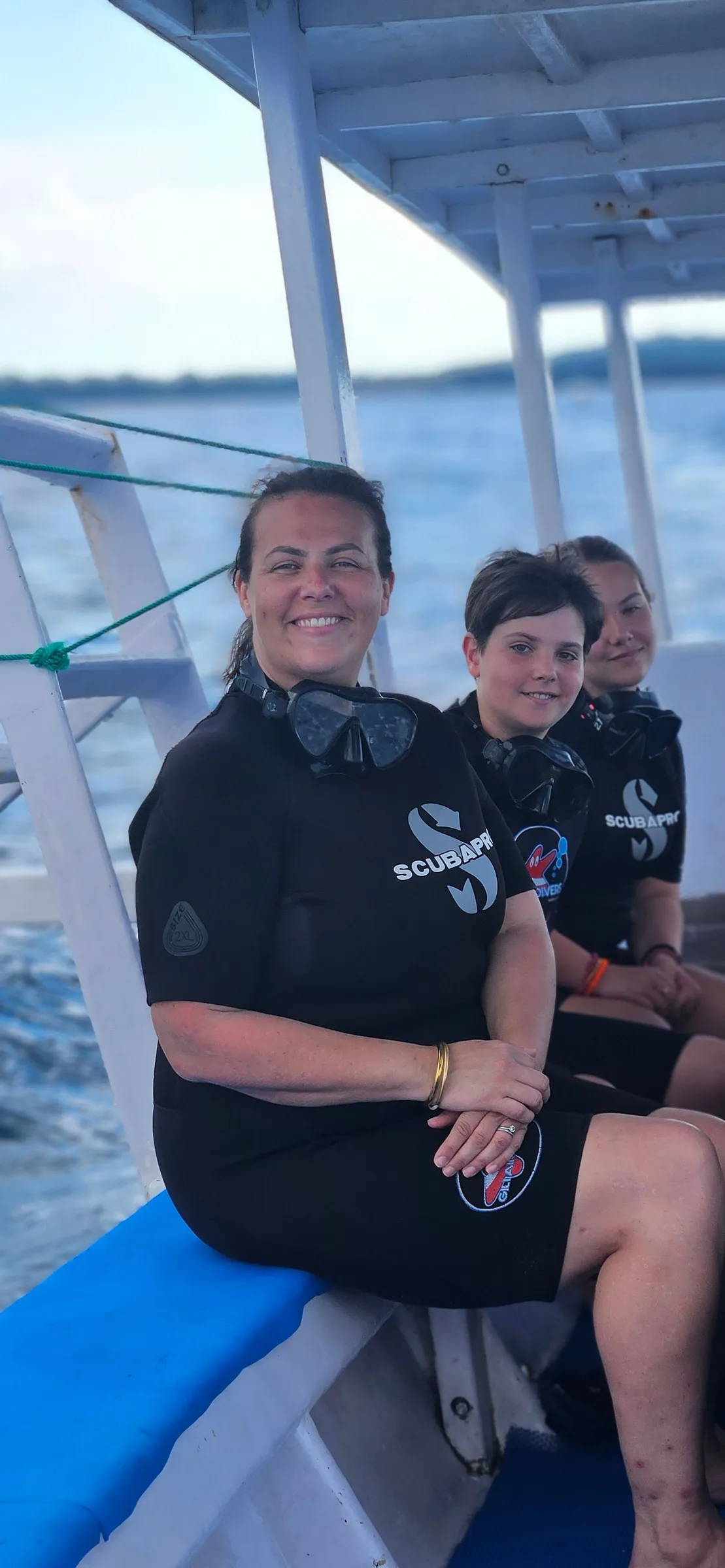
Day 5 — certification + first fun dives. Junior divers complete their final dives in the morning, get their card, and join the afternoon fun dive with the rest of the family. First time on a boat with their parents as fellow certified divers — usually the highlight of the trip.
Day 6 — Advanced day for teens, freediving option, or rest. Older teens can start Advanced (5 dives over 2 days). 14+ can try freediving. Some families take the morning off and snorkel in front of the centre. The afternoon Komodo-style fun dive at Hans Reef or Bounty Wreck is a great closer.
Day 7 — last morning dive or boat trip. A relaxed morning dive at Sunset Point or Coral Fan Garden, group photo, lunch, boat back to Bali in the afternoon.
That is the template. Most families build their week around it with one or two rest days, especially when there are younger kids in the mix.
What makes this work specifically at Gili Air
Three things, in order:
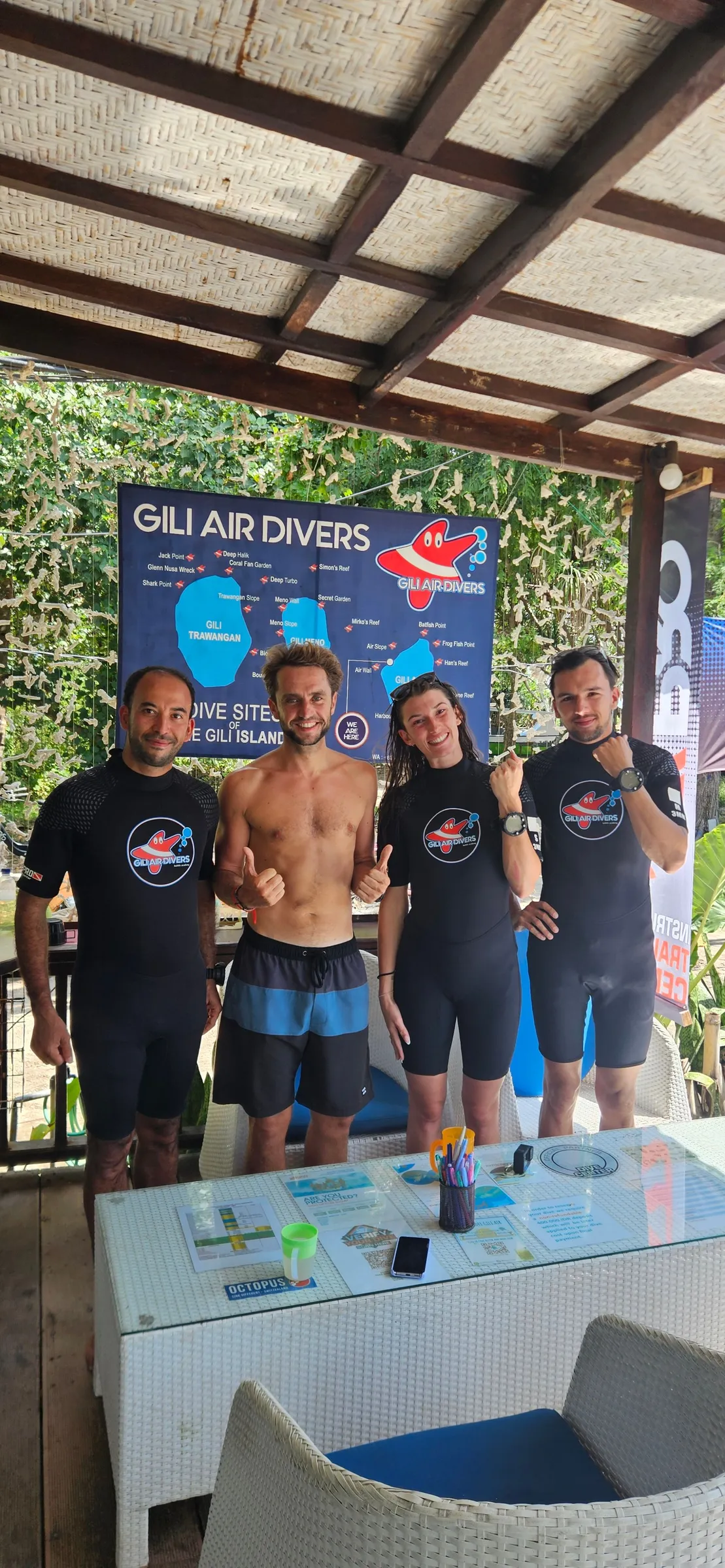
Group size. We cap dives at four students per instructor. The industry standard is eight. For families that means your guide knows your kids by name on day one, sees them individually on every dive, and adjusts the plan to the child who needs the most attention rather than the average of the group.
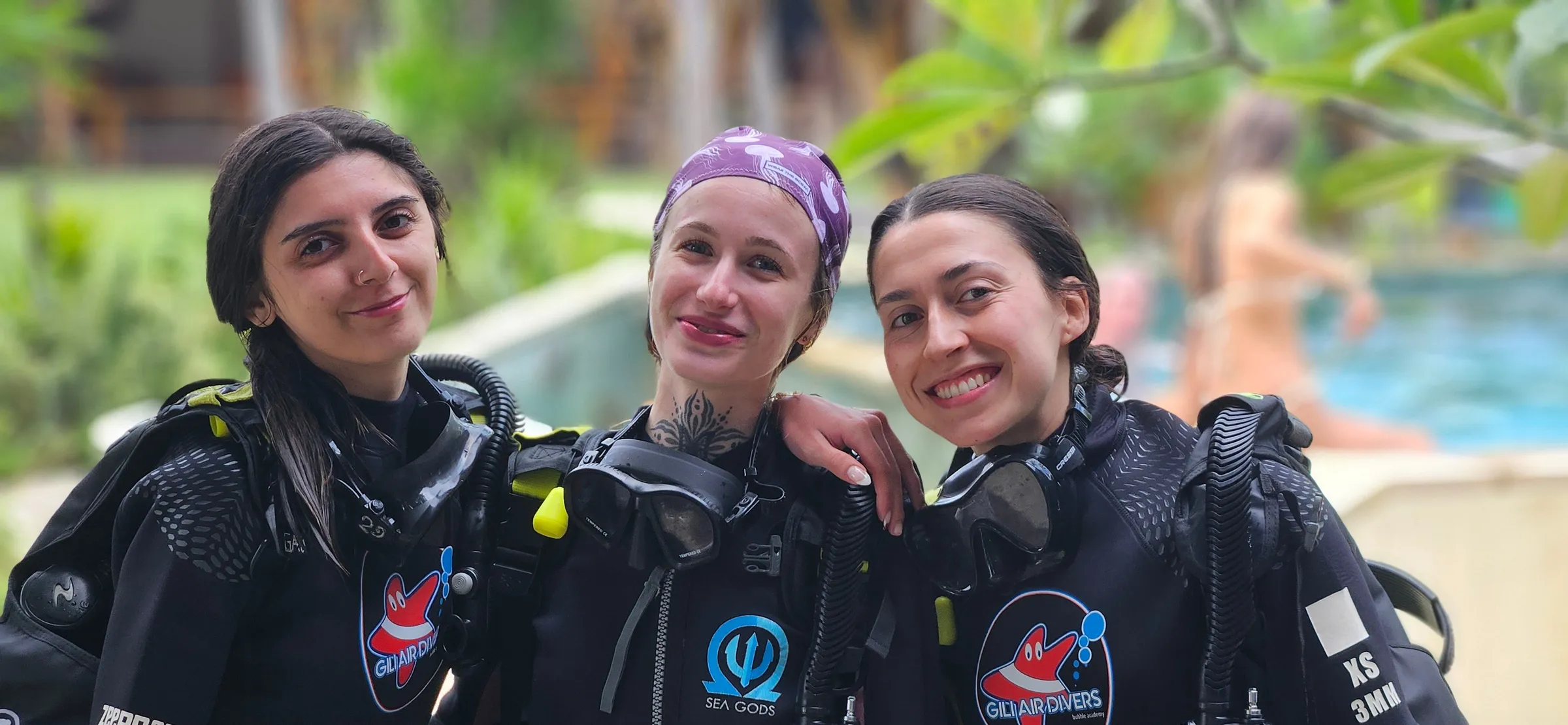
A multilingual team. Bibi (Birkan Tanis) founded the centre in 2011 as the first French-language dive school on Gili Air. We teach in English, French, Spanish and Bahasa Indonesia, and parents routinely tell us the difference made by being able to switch language mid-briefing when a worried 10-year-old has a question. Teaching is in the language the family chooses. The cards we issue are recognised worldwide regardless.
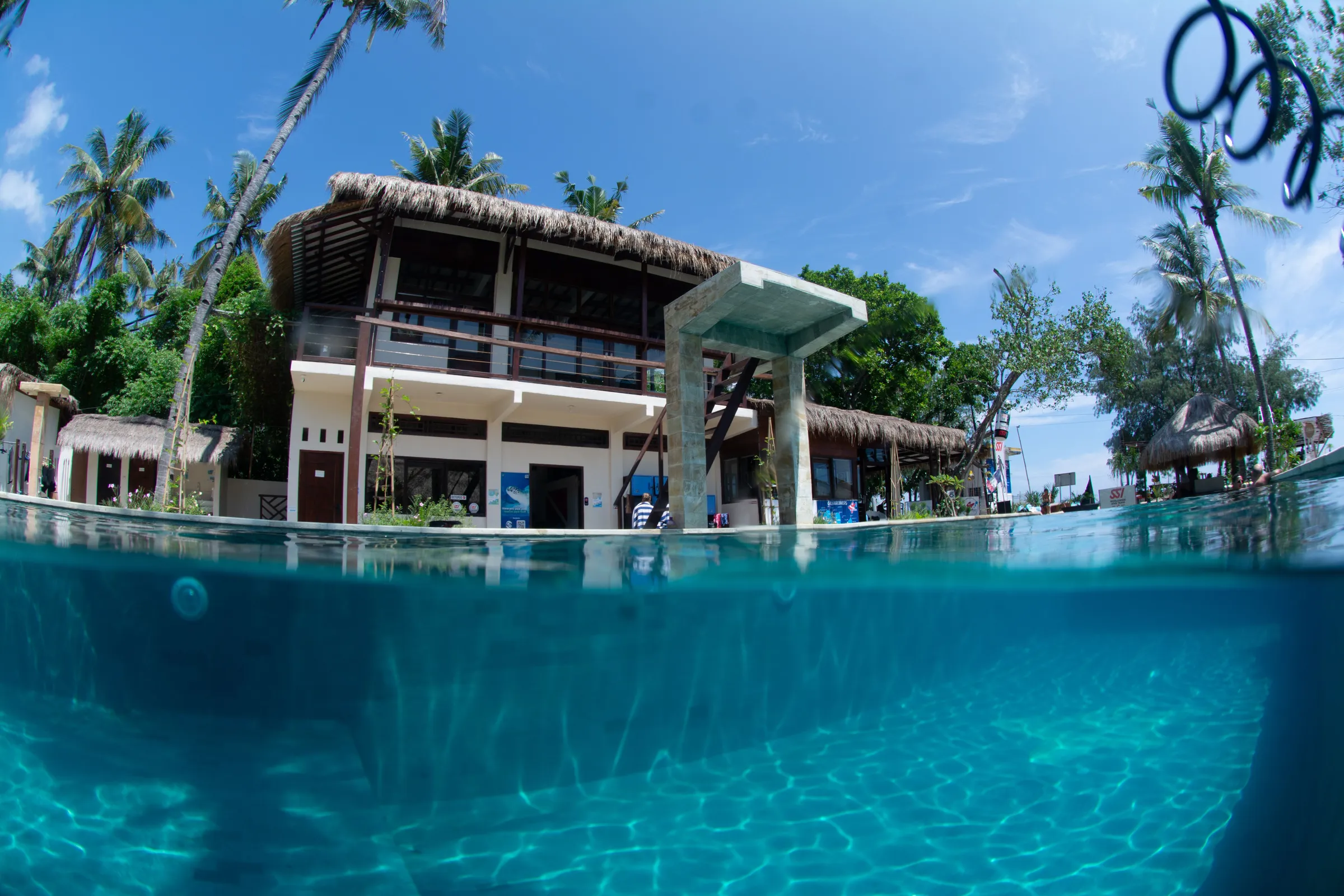
The Gili Air west coast itself. Our house reef sits on a calm sandy slope from 3 m to 26 m, dotted with turtles, blue-spotted stingrays, and clownfish anemones. Kids can spend the whole day in conditions designed to build confidence before we ever push toward the deeper sites further out.
How to put your week together
A handful of practical things to do before you book the boats.
- Check passport expiry. Indonesia requires six months past your travel date for every member of the family.
- Book accommodation early. Dry season weekends fill up. Bibi keeps a vetted list of partners across three tiers: beachfront-adjacent, short-walk, private villas. Send us your dates and we will introduce you to the right one.
- Get the kids’ SSI app account set up before flying. They can start the theory at home — videos, quizzes, a short final exam — and arrive ready for the pool. Kids who do this enjoy day one much more than the ones who start cold.
- Pack a swimsuit per day per kid. They get wet, then they get wet again. One swimsuit ages badly.
- Bring reef-safe sunscreen. Sun is intense at the equator. We use Stream2Sea at the centre and you will find it locally.
Reach us on WhatsApp at any point — Bibi answers in the language you write in, within 30 minutes during Gili Air daylight (UTC+8). Or send a quick note via the contact form and we will get back the same day.
Have a great summer in the water. We will save you a spot on the boat.